

Bottom Line Up Front (BLUF)
The Big Three’s market consolidation and geopolitical influence stem from structural advantages in passive investing, technological infrastructure (Aladdin), and regulatory arbitrage. While critics highlight systemic risks (liquidity crises, antitrust concerns), their alignment with macroeconomic trends (AI, energy transition) and lobbying power ensure continued centrality in global finance. The Big Three manage $23 trillion in assets (as of 2024), roughly equal to U.S. GDP. BlackRock ($10T), Vanguard ($9T), and State Street ($4T) collectively own 20-25% of S&P 500 companies, with projections to reach 40% in two decades. Their strategy focuses on passive index funds and ETFs, leading to stable, long-term ownership of major firms across sectors like tech, airlines, pharmaceuticals, and defense. BlackRock alone holds ≥5% in 95% of S&P 500 firms. Unlike active managers chasing short-term gains, the triopoly’s passive approach fosters resilience, ensuring firms have reliable access to capital during downturns (e.g., post-2008 recovery or COVID-19 market shocks) and further entrenches their mutual co-investment model.


I. Market Consolidation
Passive Investing as a Consolidation Tool:
BlackRock, Vanguard, and State Street collectively manage $23.7 trillion (as of Q1 2025), with passive strategies (ETFs, index funds) accounting for 70% of net inflows since 2020.
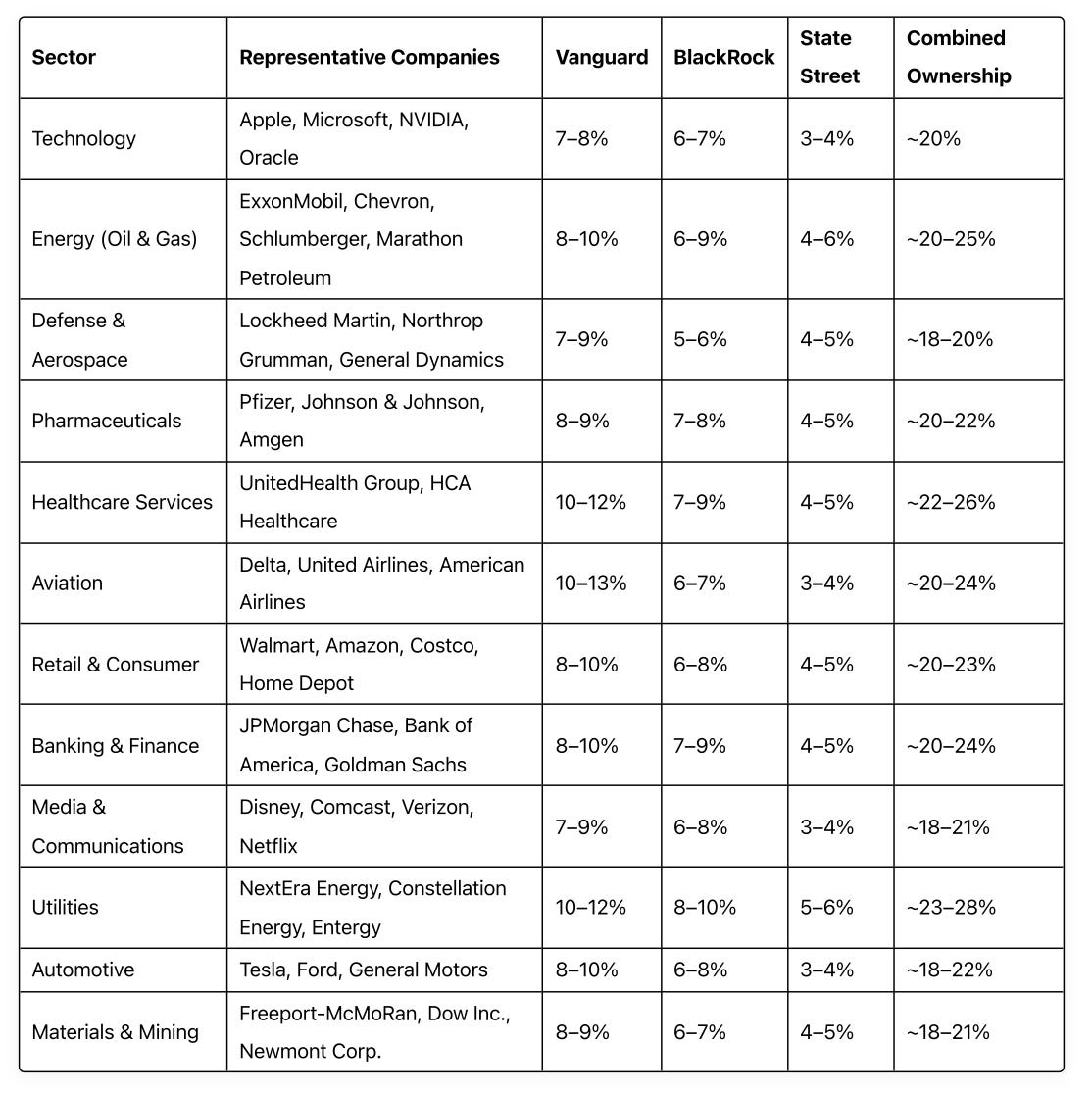
Ownership Concentration: They hold >20% stakes in 88% of S&P 500 firms, projected to reach 40% by 2045, creating systemic dependencies across sectors like tech, pharma, defense, and banking.
Acquisition-Driven Growth: BlackRock’s 2024 acquisition of Preqin ($3.2B) expanded its private markets data dominance, while Vanguard’s partnerships with insurers (e.g., Allianz) secured permanent capital for illiquid assets 23.
Economies of Scale:
Firms with >500BAUM achieve 30% lower operating costs. BlackRock’s Aladdin, which supports $21 trillion+ in third-party assets, enables this by serving as a shared infrastructure for risk management and portfolio optimisation.
Cross-Sector Influence: The Big Three are top shareholders in competing firms (e.g., Delta, United, American Airlines), raising antitrust concerns about reduced price competition.
Voting Power: The "Big Three" (BlackRock, Vanguard, State Street) collectively control ~$21 trillion in assets, granting them outsized voting power in thousands of global companies. This allows them to:
Dictate Board Appointments: Their votes often decide board elections, enabling them to install directors aligned with ESG priorities, such as climate targets or diversity mandates 11.
Shape Shareholder Resolutions: They disproportionately influence the success or failure of ESG-related proposals. For example, excluding their votes would have led to 30 additional ESG resolutions passing at S&P 100 companies in 2023 alone 13.
Suppress Dissent: By voting against resolutions deemed "too prescriptive" or redundant (e.g., racial equity audits at Apple or emissions plans at Raytheon), they steer corporate agendas toward their preferred frameworks 113.
Energy Sector Influence: By pressuring fossil fuel companies to adopt net-zero targets (e.g., via Climate Action 100+), these firms indirectly steer capital away from coal and oil. For instance, BlackRock, Vanguard, and State Street held ~30% stakes in major U.S. coal producers like Arch Resources and Peabody Energy, using their positions to curb production.
Green Tech Monopolies: Investments in lithium (Chile), cobalt (DRC), and rare earth minerals are framed as ESG-aligned but often lock developing nations into supplier roles while advanced economies retain high-value manufacturing (e.g., EV batteries).
Carbon Markets: BlackRock and State Street dominate carbon credit markets, directing capital toward projects like forest conservation in Liberia or Indonesia. These initiatives often displace local communities while generating credits for Western corporations 813.
Debt-for-Land Swaps: Through institutions like the IMF, developing nations are pressured to accept conservation agreements (e.g., Ecuador’s Galápagos deal) in exchange for debt relief, ceding sovereignty over natural resources
This control mirrors a soft power strategy, where corporate governance becomes a proxy for institutional ideology.

II. Geopolitical Leverage
Infrastructure & Energy Transition:
The Big Three channel investments into U.S. infrastructure ($1.2T via the 2021 Infrastructure Act) and AI-driven data centers, aligning with bipartisan policy goals.
BlackRock’s 2025 thematic portfolios prioritize AI infrastructure and "reshoring" manufacturing, reflecting geopolitical tensions with China and U.S. tariff policies.
Global Regulatory Arbitrage:
In Europe, partnerships with firms like Amundi and Norges Bank replicate passive strategies, while exploiting EU Green Deal incentives for renewable energy projects.
State Street’s SPDR ETFs are tailored to emerging markets (e.g., India’s renewable sector), leveraging local regulatory frameworks to expand influence.
Technological Infrastructure as Geopolitical Power:
Aladdin’s Ecosystem: BlackRock’s Aladdin platform is used by 75% of central banks and sovereign wealth funds, giving it indirect control over $21 trillion+ in third-party assets. For example, Sumitomo Mitsui Trust uses Aladdin to manage $620B AUM, relying on BlackRock’s risk models for decision-making.
Data Monopolies: Preqin’s integration into Aladdin gives BlackRock control over 90% of private market benchmarks, raising concerns about biased pricing models.
AI-driven portfolio optimization (e.g., BlackRock’s GPT-4 integration) and blockchain settlement systems may further entrench the Big Three’s dominance in asset servicing
Blockchain: iShares Bitcoin ETF ($100B AUM) position it as a gatekeeper in digital asset regulation debates.
Consolidation of Power
Voting Rights: The Big Three (BlackRock, Vanguard, State Street) control ~25% of votes at S&P 500 shareholder meetings. The Big Three vote on behalf of 150M+ passive investors, yet <5% of fundholders engage in proxy voting.
State Street’s 2024 pilot for “pass-through voting” (allowing ETF holders to vote directly) remains limited to 0.1% of its AUM.
They support management proposals >90% of the time, effectively consolidating power with corporate boards.
Sectoral Control: They hold >30% stakes in sectors like tech (Apple, Microsoft), defense (Lockheed Martin), and banking (JPMorgan), ailines (e.g., Delta, United, and American Airlines), creating incentives to reduce price competition. Common ownership of competing firms (e.g., major airlines, defence contractors) reduces competition, with studies showing effects like price coordination in some sectors. This has drawn scrutiny from the DOJ and FTC.
Lobbying Influence: The Big Three spent $18M on U.S. federal lobbying in 2024, focusing on climate disclosure rules (SEC) and private market regulations.
In Asia, BlackRock’s advisory role to Japan’s GPIF ($1.6T AUM) shapes regional pension fund allocations toward U.S. Treasuries and tech ETFs.
III. Regulatory Scrutiny & Systemic Fragility
Market Fragility: Passive funds’ “buy-and-hold” strategy amplifies volatility during liquidity crises (e.g., March 2020 ETF sell-offs). BlackRock’s Aladdin flagged a 25% increase in liquidity risk alerts in 2024.
Antitrust Investigations:
The FDIC proposed capping passive fund ownership in banks at 10% (2024) amid concerns over voting power concentration. BlackRock and Vanguard hold 15–18% stakes in JPMorgan, Bank of America, and Citigroup.
The DOJ’s 2024 inquiry into airline sector common ownership highlighted academic studies linking Big Three stakes to 3–7% higher ticket prices.
Historical Context
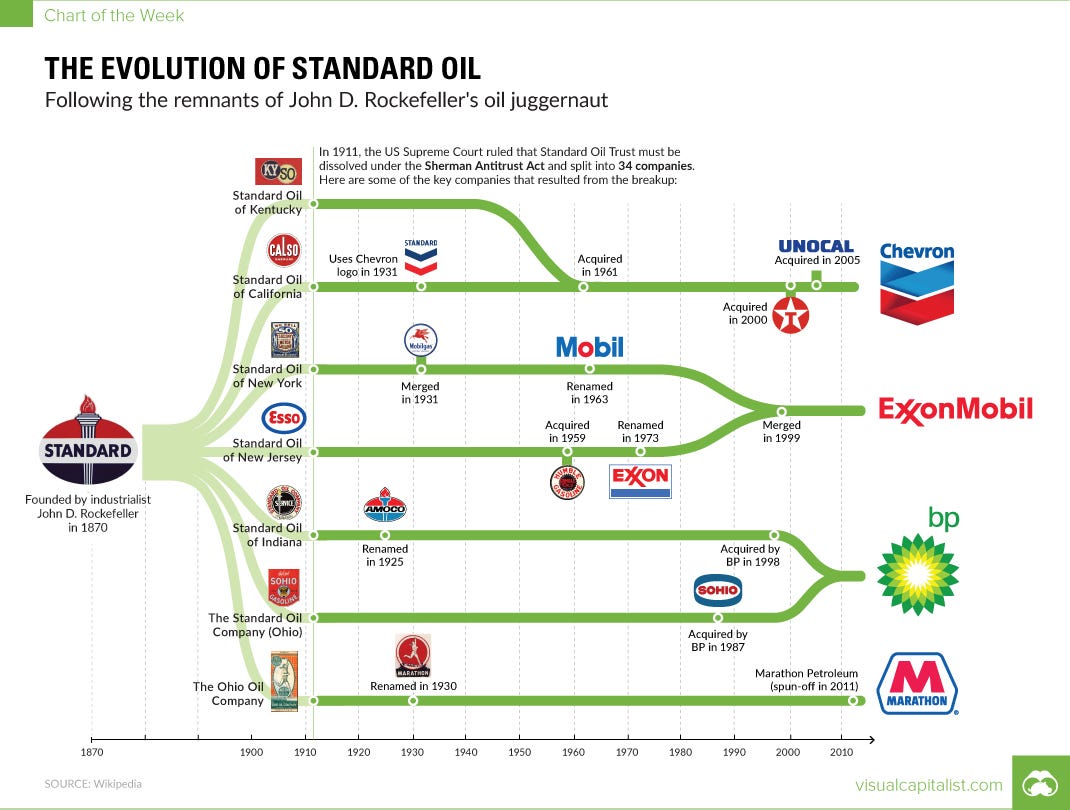
In the year 1904, John D. Rockefeller’s Standard Oil controlled 91% of oil production and 85% of final sales in the United States. As a result, an antitrust case was filed against the company in 1906 under the Sherman Antitrust Act. The standard Oil monopoly was split into 34 separate entities, mainly based on geographical area. Today, the biggest of these companies form the core of the U.S. oil industry:
Standard Oil of New Jersey: Merged with Humble Oil and eventually became Exxon
Standard Oil of New York: Merged with Vacuum Oil, and eventually became Mobil
Standard Oil of California: Acquired Standard Oil of Kentucky, Texaco, and Unocal, and is now Chevron
Standard Oil of Indiana: Renamed Amoco, and was acquired by BP
Standard Oil of Ohio: Acquired by BP
The Ohio Oil Company: Became Marathon Oil, which eventually also spun-off Marathon Petroleum
While, unlike Standard Oil, the Big Three act merely as fiduciaries for clients—their control over proxy voting across all major industries grants them unprecedented influence over corporate governance. Investors in passive funds (e.g. Pension funds, Mutual funds, ETF’s) rarely exercise direct control over their shares, resulting in centralized voting power residing with the asset managers. This structure effectively concentrates voting rights, board composition and corporate governance control in a small number of institutions - while “ownership” remains technically more dispersed – avoiding regulatory scrutiny.
Conclusion:
This level of concentration of wealth and influence (among ~200 senior executives) is historically unprecedented in private capital markets and positions them as central actors in global economic decision-making, with systemic influence across key sectors including technology, defense, energy, and finance. The consolidation is primarily driven by passive investment vehicles—index funds and ETFs—which attract the majority of new capital inflows due to their low costs and broad exposure. Through these instruments, the Big Three have acquired long-term, stable ownership in thousands of public companies. Their voting rights are executed centrally, not by individual investors, with less than 5% of fundholders participating in proxy voting. Their stewardship programs deviate from direct fiduciary obligations and include the activist promotion of ESG frameworks, global governance, stakeholder capitalism, and public-private partnerships. Activist investing initiatives, often led by Western financial giants, reflect the ideological preferences of a western elites more broadly. As such, ESG’s rhetoric of saving the planet and promoting equity operates as a pretext for the Big Three to exercise legitimate authority over boards, markets, and even government policy. Their leadership (e.g., Fink, Vanguard’s Tim Buckley, State Street’s Ron O’Hanley) overlaps with WEF, UN, and G20 advisory boards, and the trio signed UN Principles for Responsible Investment, aligning with global governance frameworks. Activist investing policies, enforced by powerful asset managers or international organizations, can pressure states and their industries to comply with external standards, bypassing national decision-making.
End of Brief.
[For more information on Section 14 please click here.]